AI Product Engineer adalah karir baru yang menggabungkan kemampuan product thinking, AI tools mastery, dan development skills untuk membangun produk AI-powered. Dalam artikel komprehensif ini, kita bahas detail job description, responsibilities, tools yang digunakan, contoh output kerjaan, cara belajar step-by-step, persiapan portfolio, hingga rekomendasi kelas dari BuildWithAngga.
Opening: Karir Baru yang Sedang Naik Daun
Sejak Januari 2025, saya menambahkan satu title baru di samping Founder BuildWithAngga: AI Product Engineer. Dan saya bisa bilang — ini adalah salah satu career pivot paling exciting yang pernah saya lakukan.
Kenapa? Karena untuk pertama kalinya dalam sejarah tech, kita punya kemampuan untuk build products yang sebelumnya butuh tim besar, budget jutaan dollar, dan waktu bertahun-tahun — sekarang bisa dikerjakan oleh satu orang dalam hitungan minggu atau bahkan hari.
Shayna AI, salah satu produk yang sedang saya kembangkan, adalah website builder yang powered by AI. Dulu, untuk build tool seperti ini, kamu butuh:
- Tim ML engineers untuk model development
- Backend engineers untuk infrastructure
- Frontend engineers untuk interface
- Product managers untuk strategy
- Dan budget yang sangat besar
Sekarang? Dengan kombinasi AI APIs yang sudah mature, no-code tools yang powerful, dan vibe coding approach — satu orang dengan skill yang tepat bisa build dan ship produk serupa.
Ini bukan exaggeration. Ini realita baru.
Kenapa Saya Menulis Artikel Ini
Selama 7+ tahun mengajar di BuildWithAngga dengan 900.000+ students, saya selalu berusaha identify skills dan karir yang akan relevant di masa depan. Dan AI Product Engineer adalah salah satu yang paling promising.
Tapi ada masalah: informasi tentang role ini masih sangat terbatas, terutama dalam konteks Indonesia. Kebanyakan content yang ada fokus pada AI/ML Engineering yang butuh background PhD dan deep mathematics — sangat intimidating untuk kebanyakan orang.
Padahal AI Product Engineer berbeda. Role ini lebih accessible, lebih practical, dan arguably lebih dibutuhkan di market saat ini.
Dalam artikel ini, saya akan share:
- Apa sebenarnya AI Product Engineer itu (dan bedanya dengan role lain)
- Job description dan daily responsibilities secara detail
- Skills yang dibutuhkan dan bagaimana mendapatkannya
- Tools yang digunakan sehari-hari
- Contoh nyata output kerjaan
- Step-by-step cara belajar dari nol
- Cara menyiapkan portfolio yang compelling
- Ekspektasi gaji dan career path
- Rekomendasi kelas untuk memulai
Siapa yang cocok baca artikel ini?
Artikel ini untuk kamu yang:
- Developer yang ingin leverage AI dalam pekerjaan
- Designer yang ingin expand ke building products
- Product manager yang ingin lebih hands-on
- Fresh graduate yang mencari karir di tech
- Career switcher yang tertarik dengan AI
- Siapa saja yang ingin build AI-powered products
Mari kita mulai.
Section 1: Apa Itu AI Product Engineer?
Definisi yang Jelas
Sebelum kita deep dive, mari kita clear kan dulu apa yang BUKAN AI Product Engineer:
AI PRODUCT ENGINEER BUKAN:

❌ AI/ML Engineer
   └── Mereka fokus pada training models, deep learning,
       research papers, dan mathematical optimization

❌ Data Scientist
   └── Mereka fokus pada analysis, statistics,
       dan extracting insights dari data

❌ Software Engineer yang pakai ChatGPT
   └── Occasional AI usage bukan berarti AI Product Engineer

❌ Product Manager yang strategize tentang AI
   └── PM biasanya tidak hands-on build products
Lalu apa sebenarnya AI Product Engineer?
AI PRODUCT ENGINEER ADALAH:

✅ Hybrid role yang menggabungkan:
   ├── Product Thinking: Identify problems, design solutions
   ├── AI Expertise: Leverage AI tools dan APIs effectively
   └── Building Skills: Actually ship working products

✅ Fokus pada:
   ├── Building AI-powered products dari ide sampai production
   ├── Integrating AI capabilities ke dalam user experiences
   ├── Shipping fast dan iterating based on feedback
   └── Making AI accessible untuk end users

✅ Output utama:
   └── Working AI products yang solve real problems
Sederhananya: AI Product Engineer adalah orang yang bisa transform ide menjadi AI-powered product yang working dan useful.
Perbedaan dengan Role Lain
Untuk lebih jelasnya, ini comparison table:
| Aspect | AI/ML Engineer | Software Engineer | Product Manager | AI Product Engineer |
|---|---|---|---|---|
| Primary Focus | Model development & training | Application code & systems | Strategy & roadmap | AI-powered products |
| Technical Depth | Very deep (PhD level) | Deep in specific stack | Moderate | Broad, practical |
| AI Knowledge | Create & train AI models | Use AI occasionally | Understand AI concepts | Leverage AI extensively |
| Coding | Python, ML frameworks | Full stack programming | Usually minimal | Practical, AI-assisted |
| Product Sense | Often limited | Varies | Very strong | Strong |
| Main Output | Models, algorithms | Apps, features | Specs, roadmaps | Complete AI products |
| Tools | PyTorch, TensorFlow, Jupyter | React, Node, databases | Jira, Figma, analytics | AI APIs, no-code, Cursor |
Kenapa Role Ini Muncul Sekarang?
AI Product Engineer bukan role yang exist 5 tahun lalu. Beberapa faktor yang membuat role ini emerge:
1. AI APIs Menjadi Accessible
Dulu, untuk build AI features, kamu harus:
- Collect dan clean massive datasets
- Train models dari scratch
- Setup expensive GPU infrastructure
- Hire PhD researchers
Sekarang? Kamu bisa call OpenAI API atau Claude API dan dapat access ke state-of-the-art AI capabilities dalam hitungan menit. Barrier to entry turun drastis.
2. Gap antara AI Capability dan Product Implementation
Banyak company punya akses ke AI technology tapi struggle untuk turn it into useful products. Mereka butuh orang yang bisa:
- Understand AI capabilities dan limitations
- Translate capabilities ke user-facing features
- Build dan iterate quickly
- Ship to production
AI/ML Engineers terlalu fokus pada model development. Software Engineers sering tidak familiar dengan AI paradigm. Product Managers tidak hands-on. AI Product Engineer fill gap ini.
3. Tools untuk Building Makin Powerful
- Cursor/Claude Code: AI-assisted coding yang game-changing
- Lovable AI: Build full apps dari prompt
- Vercel/Railway: One-click deployment
- Supabase: Backend in minutes
Dengan tools ini, satu orang bisa build apa yang dulu butuh tim.
4. Companies Butuh Speed
Di AI race saat ini, speed to market adalah everything. Companies butuh orang yang bisa:
- Prototype dalam hari, bukan bulan
- Ship MVP quickly
- Iterate based on real user feedback
- Move fast tanpa sacrificing quality
AI Product Engineer adalah role yang optimized untuk speed.
Analogi yang Membantu
Kalau masih bingung, coba analogi ini:
AI/ML Engineer = Orang yang bikin mesin mobil dari nol. Mereka understand thermodynamics, material science, dan engineering principles deeply.
Software Engineer = Orang yang bikin mobil dengan mesin yang sudah ada. Mereka assemble parts, build the body, create the electrical systems.
AI Product Engineer = Orang yang bikin kendaraan baru (bisa mobil, bisa motor, bisa yang lain) dengan parts yang sudah tersedia (termasuk AI parts), fokus pada: apakah kendaraan ini solve transportation problem untuk user dengan baik?
Yang terakhir ini tidak perlu bisa bikin mesin dari nol. Tapi mereka harus tau mesin mana yang cocok untuk use case apa, bagaimana integrate-nya, dan bagaimana deliver experience yang baik ke user.
Section 2: Job Description & Responsibilities
Sekarang let's get practical. Apa sebenarnya yang dikerjakan AI Product Engineer sehari-hari?
Core Responsibilities
1. Product Discovery & Problem Identification
Sebelum build apapun, AI Product Engineer harus bisa identify problems yang worth solving — dan yang bisa di-solve dengan AI.
PRODUCT DISCOVERY TASKS:

├── User Research
│   ├── Interview potential users
│   ├── Analyze existing pain points
│   ├── Identify patterns dan common problems
│   └── Validate assumptions dengan data
│
├── Opportunity Assessment
│   ├── Mana problems yang bisa di-solve dengan AI?
│   ├── Mana yang AI actually better than traditional solutions?
│   ├── What's the market size?
│   └── Who are the competitors?
│
├── Feasibility Analysis
│   ├── Apakah AI technology untuk ini sudah mature?
│   ├── What APIs/models are available?
│   ├── What are the costs?
│   └── What are the limitations?
│
└── MVP Definition
    ├── What's the smallest version that delivers value?
    ├── Which AI features are must-have vs nice-to-have?
    ├── What's the success metric?
    └── What's the timeline?
2. AI Solution Design
Setelah problem jelas, next step adalah design solution yang leverage AI effectively.
AI SOLUTION DESIGN TASKS:

├── AI Architecture Decisions
│   ├── Which AI model/API to use?
│   ├── GPT-4 vs Claude vs open source?
│   ├── Single model vs multiple models?
│   └── Real-time vs batch processing?
│
├── Prompt Engineering Strategy
│   ├── System prompt design
│   ├── User input handling
│   ├── Output formatting
│   ├── Error handling
│   └── Edge case management
│
├── Data Flow Design
│   ├── How does user input flow to AI?
│   ├── How is AI output processed?
│   ├── What gets stored?
│   └── How is context maintained?
│
├── Fallback Mechanisms
│   ├── What happens when AI fails?
│   ├── Rate limit handling
│   ├── Timeout handling
│   └── Graceful degradation
│
└── Cost Optimization
    ├── How to minimize API calls?
    ├── Caching strategies
    ├── Model selection for cost vs quality
    └── Usage monitoring
3. Building & Implementation
Ini adalah core of the work — actually building the product.
BUILDING TASKS:

├── AI Integration
│   ├── Setup API connections (OpenAI, Anthropic, etc)
│   ├── Implement prompt templates
│   ├── Build prompt chains kalau perlu
│   ├── Setup streaming responses
│   └── Implement retry logic
│
├── Frontend Development
│   ├── Build user interfaces untuk AI features
│   ├── Handle loading states
│   ├── Display AI outputs nicely
│   ├── Create input forms
│   └── Build feedback mechanisms
│
├── Backend Development
│   ├── API endpoints untuk AI features
│   ├── Database schema untuk storing results
│   ├── Authentication & authorization
│   ├── Rate limiting
│   └── Logging & monitoring
│
├── RAG Implementation (kalau perlu)
│   ├── Document processing
│   ├── Embedding generation
│   ├── Vector database setup
│   ├── Retrieval logic
│   └── Context injection
│
└── Vibe Coding dengan AI
    ├── Use Cursor/Claude untuk accelerate coding
    ├── Generate boilerplate dengan AI
    ├── Debug dengan AI assistance
    └── Refactor dengan AI suggestions
4. Testing & Quality Assurance
AI products butuh testing approach yang berbeda dari traditional software.
TESTING TASKS:

├── AI Output Testing
│   ├── Test dengan berbagai inputs
│   ├── Check for hallucinations
│   ├── Verify factual accuracy
│   ├── Test edge cases
│   └── Check for harmful outputs
│
├── Prompt Testing
│   ├── A/B test different prompts
│   ├── Test prompt robustness
│   ├── Measure output quality
│   └── Optimize for consistency
│
├── Integration Testing
│   ├── End-to-end flow testing
│   ├── Error handling verification
│   ├── Performance testing
│   └── Load testing
│
├── User Testing
│   ├── Usability testing
│   ├── Gather feedback
│   ├── Identify confusion points
│   └── Measure task completion
│
└── Cost Monitoring
    ├── Track API usage
    ├── Monitor costs per user
    ├── Identify optimization opportunities
    └── Set up alerts
5. Shipping & Maintenance
Building adalah satu hal. Shipping dan maintaining adalah skill tersendiri.
SHIPPING & MAINTENANCE TASKS:

├── Deployment
│   ├── Setup production environment
│   ├── Configure CI/CD
│   ├── Environment variables management
│   ├── SSL & security setup
│   └── Domain configuration
│
├── Monitoring
│   ├── Error tracking (Sentry, etc)
│   ├── Performance monitoring
│   ├── AI output quality monitoring
│   ├── User analytics
│   └── Cost dashboards
│
├── Iteration
│   ├── Analyze user feedback
│   ├── Identify improvement areas
│   ├── Update prompts
│   ├── Add features
│   └── Fix bugs
│
└── Scaling
    ├── Handle increased load
    ├── Optimize database queries
    ├── Implement caching
    ├── Manage API rate limits
    └── Cost optimization at scale
Typical Week of an AI Product Engineer
Untuk give you realistic picture, ini contoh schedule seminggu:
MONDAY — Planning & Research
━━━━━━━━━━━━━━━━━━━━━━━━━━━━━━
09:00 - 10:00  Review weekend feedback & metrics
10:00 - 11:00  Team sync / standup
11:00 - 12:00  Research: New AI tools & updates
               (OpenAI ada release baru? Claude update?)

14:00 - 16:00  Plan sprint priorities
16:00 - 17:00  Respond to user support/feedback
17:00 - 18:00  Document learnings dari minggu lalu

TUESDAY — Deep Building
━━━━━━━━━━━━━━━━━━━━━━━━━━━━━━
09:00 - 12:00  Deep work: Feature development
               (No meetings, fokus coding)

14:00 - 17:00  Continue building
17:00 - 18:00  Code review & commit

WEDNESDAY — AI Work
━━━━━━━━━━━━━━━━━━━━━━━━━━━━━━
09:00 - 11:00  Prompt engineering & testing
11:00 - 12:00  A/B test analysis

14:00 - 16:00  AI integration work
16:00 - 18:00  Testing edge cases

THURSDAY — Polish & Test
━━━━━━━━━━━━━━━━━━━━━━━━━━━━━━
09:00 - 11:00  QA dan bug fixing
11:00 - 12:00  User interview (kalau scheduled)

14:00 - 15:00  Cost analysis & optimization
15:00 - 17:00  Documentation updates
17:00 - 18:00  Prepare for deployment

FRIDAY — Ship & Learn
━━━━━━━━━━━━━━━━━━━━━━━━━━━━━━
09:00 - 11:00  Deploy to production
11:00 - 12:00  Monitor initial metrics

14:00 - 15:00  Retrospective
15:00 - 17:00  Learning time: New tools, techniques
17:00 - 18:00  Plan for next week
What You DON'T Do
Equally important adalah understand apa yang BUKAN job kamu:
THINGS AI PRODUCT ENGINEER DOESN'T DO:

❌ Train ML models from scratch
   └── You use pre-trained models via APIs

❌ Deep mathematical optimization
   └── Focus on application, not theory

❌ Write research papers
   └── You ship products, not publications

❌ Heavy DevOps/Infrastructure
   └── Use managed services (Vercel, Railway, Supabase)

❌ Pure product management without building
   └── You're hands-on, not just strategizing

❌ Detailed UI/UX design
   └── You can use templates, AI-generated UI,
       or collaborate with designers

❌ Customer support full-time
   └── You build, others support (or automate with AI!)
Skills Indicator: Are You Ready?
Quick self-assessment — kalau kamu bisa jawab "yes" untuk majority, kamu ready untuk start learning:
READINESS CHECKLIST:

□ Pernah build website/app sederhana (apapun)
□ Familiar dengan at least satu programming language
□ Pernah pakai ChatGPT/Claude untuk work
□ Understand basic concepts: API, database, frontend/backend
□ Bisa belajar tools baru dengan cepat
□ Nyaman dengan ambiguity dan figuring things out
□ Interested in products, not just technology
□ Mau ship things, not just learn theory

Score:
├── 6-8: You're ready, let's go!
├── 4-5: Some foundation work needed, but doable
├── 0-3: Start with fundamentals first
Lanjut ke Section 3: Skills yang Dibutuhkan →
Section 3: Skills yang Dibutuhkan
Sekarang pertanyaan penting: skills apa yang harus kamu punya untuk jadi AI Product Engineer?
Kabar baiknya: kamu tidak perlu jadi expert di semua area. Yang penting adalah punya kombinasi skills yang cukup untuk bisa ship products.
Skill Pyramid
Saya visualisasikan skills AI Product Engineer sebagai pyramid dengan 3 layers:
                    ┌─────────────────────┐
                    │    AI MASTERY       │  ← Differentiator
                    │  Prompt Engineering │
                    │   AI APIs & Tools   │
                    └──────────┬──────────┘
                               │
                ┌──────────────┴──────────────┐
                │     DEVELOPMENT SKILLS       │  ← Core
                │   Frontend, Backend, APIs    │
                │   No-code, Deployment        │
                └──────────────┬──────────────┘
                               │
        ┌──────────────────────┴──────────────────────┐
        │            PRODUCT THINKING                  │  ← Foundation
        │   User Research, Problem Solving, Metrics   │
        │   Prioritization, MVP Mindset               │
        └─────────────────────────────────────────────┘
Layer paling bawah adalah foundation — tanpa ini, kamu akan build products yang tidak ada yang mau pakai. Layer tengah adalah core skills — ini yang memungkinkan kamu actually build. Layer atas adalah differentiator — ini yang membuat kamu AI Product Engineer, bukan just developer.
Mari kita breakdown satu per satu.
Layer 1: Product Thinking (Foundation)
Ini adalah skill yang sering di-skip oleh orang technical, tapi actually paling penting. Kamu bisa jago coding dan AI, tapi kalau build product yang nobody wants, percuma.
PRODUCT THINKING SKILLS:

User Problem Identification
├── Cara interview users yang efektif
├── Identify real problems vs perceived problems
├── Distinguish "nice to have" vs "must have"
└── Empathy untuk user pain points

Solution Design
├── Brainstorm multiple solutions
├── Evaluate trade-offs
├── Design MVP (Minimum Viable Product)
└── Create user flows

Prioritization
├── Framework: Impact vs Effort matrix
├── MoSCoW method (Must/Should/Could/Won't)
├── Saying "no" to good ideas untuk focus on great ones
└── Sequencing: what to build first

Metrics & Success Definition
├── Define what "success" looks like
├── Choose right metrics (not vanity metrics)
├── Setup tracking
└── Make data-driven decisions

Business Understanding
├── How does the product make money?
├── Who are competitors?
├── What's the market size?
└── Unit economics basics
Bagaimana belajar Product Thinking?
- Baca buku "Inspired" by Marty Cagan (atau summary-nya)
- Practice: Interview 5 orang tentang problems mereka
- Analyze products yang kamu pakai: kenapa mereka designed seperti itu?
- Build something small dan get real user feedback
Layer 2: Development Skills (Core)
Ini adalah skills yang memungkinkan kamu transform ideas menjadi working products.
Frontend Development
| Skill | Priority | What to Learn |
|---|---|---|
| HTML/CSS | Must Have | Structure, styling, responsive design |
| JavaScript | Must Have | DOM manipulation, async/await, fetch API |
| React atau Vue | Should Have | Component-based development |
| Tailwind CSS | Should Have | Rapid styling |
| Next.js | Nice to Have | Full-stack React framework |
Backend Development
| Skill | Priority | What to Learn |
|---|---|---|
| REST API concepts | Must Have | HTTP methods, status codes, request/response |
| One backend language | Must Have | Node.js, Python, atau PHP/Laravel |
| Database basics | Must Have | SQL, CRUD operations |
| Authentication | Should Have | JWT, sessions, OAuth basics |
| Serverless | Nice to Have | Vercel functions, AWS Lambda |
No-Code/Low-Code Tools
| Tool | Use Case | Learning Time |
|---|---|---|
| Lovable AI | Full apps dari prompt | 1-2 days |
| Webflow | Marketing websites | 1 week |
| Bubble | Complex web apps | 2-3 weeks |
| Supabase | Backend as a service | 2-3 days |
| Firebase | Quick backend setup | 2-3 days |
DevOps Basics
| Skill | Priority | What to Learn |
|---|---|---|
| Git & GitHub | Must Have | Version control, collaboration |
| Basic deployment | Must Have | Vercel, Netlify, Railway |
| Environment variables | Must Have | Managing secrets |
| Domain & SSL | Should Have | Custom domains, HTTPS |
| Docker | Nice to Have | Containerization basics |
Pro tip: Kamu tidak perlu master semua ini sebelum mulai. Learn just enough untuk build, lalu learn more as needed. Dengan AI coding assistants, kamu bisa build dengan knowledge yang lebih sedikit dari sebelumnya.
Layer 3: AI-Specific Skills (Differentiator)
Ini adalah skills yang specifically membuat kamu AI Product Engineer.
Prompt Engineering (Critical)
PROMPT ENGINEERING SKILLS:

Basic Prompting
├── Writing clear, specific instructions
├── Providing context
├── Specifying output format
└── Setting constraints

Advanced Techniques
├── Chain-of-thought prompting
│   └── "Let's think step by step..."
├── Few-shot learning
│   └── Provide examples in prompt
├── Role prompting
│   └── "You are an expert..."
└── Output parsing
    └── JSON mode, structured outputs

System Prompt Design
├── Define AI personality/behavior
├── Set boundaries dan rules
├── Handle edge cases
├── Maintain consistency
└── Version control prompts

Prompt Optimization
├── A/B testing different prompts
├── Measuring output quality
├── Reducing tokens untuk cost
├── Balancing quality vs speed
└── Iterating based on failures
AI API Integration (Critical)
AI API SKILLS:

Core APIs to Know:
├── OpenAI API
│   ├── Chat completions (GPT-4, GPT-4o)
│   ├── Image generation (DALL-E)
│   ├── Speech-to-text (Whisper)
│   ├── Text-to-speech
│   └── Embeddings
│
├── Anthropic API
│   ├── Claude models (best for coding & reasoning)
│   ├── Long context handling
│   └── Constitutional AI safety
│
├── Google AI
│   ├── Gemini models
│   ├── Stitch (UI generation)
│   └── Various specialized models
│
└── Specialized APIs
    ├── ElevenLabs (voice cloning)
    ├── Replicate (open source models)
    ├── Stability AI (image generation)
    └── Hugging Face (model hosting)

Integration Skills:
├── API authentication
├── Request/response handling
├── Streaming responses
├── Error handling & retries
├── Rate limit management
└── Cost tracking
RAG (Retrieval Augmented Generation) - Important
RAG SKILLS:

Concepts:
├── What is RAG dan kenapa penting
├── Embeddings dan vector similarity
├── Chunking strategies
└── Context window management

Implementation:
├── Document processing (PDF, docs, web)
├── Generating embeddings
├── Vector database setup
│   ├── Pinecone
│   ├── Weaviate
│   ├── Supabase pgvector
│   └── Chroma
├── Similarity search
└── Context injection ke prompts

Use Cases:
├── Q&A over documents
├── Customer support bots
├── Knowledge base search
└── Personalized recommendations
AI Tools Mastery (Important)
AI TOOLS TO MASTER:

For Coding:
├── Cursor ────────── AI-first code editor
├── Claude ────────── Best for complex coding tasks
├── GitHub Copilot ── Inline code suggestions
└── Claude Code ───── Terminal AI assistant

For Building:
├── Lovable AI ────── Full apps dari prompt
├── v0 by Vercel ──── React components
├── Bolt.new ──────── Quick prototypes
└── Replit ────────── Browser-based development

For Design:
├── Midjourney ────── Image generation
├── DALL-E ────────── OpenAI image generation
├── Galileo AI ────── UI dari text
└── Figma AI ──────── Design assistance
Skills Priority Matrix
Tidak semua skills sama pentingnya di setiap stage. Ini priority berdasarkan experience level:
BEGINNER (0-6 months):
━━━━━━━━━━━━━━━━━━━━━
FOCUS ON:
├── HTML, CSS, JavaScript basics
├── One backend (Node.js atau Laravel)
├── Git basics
├── Basic prompt engineering
├── Satu no-code tool (Lovable AI)
└── Product thinking fundamentals

SKIP FOR NOW:
├── Advanced frameworks
├── DevOps
├── RAG systems
└── Multiple AI APIs

INTERMEDIATE (6-12 months):
━━━━━━━━━━━━━━━━━━━━━━━━
ADD:
├── React atau Vue
├── Database design
├── Advanced prompting
├── Multiple AI APIs
├── Basic RAG
└── Deployment & monitoring

ADVANCED (12+ months):
━━━━━━━━━━━━━━━━━━━━━━━
ADD:
├── System design
├── Complex RAG implementations
├── Cost optimization
├── Team leadership
├── AI product strategy
└── Scaling & infrastructure
Section 4: Tools yang Digunakan
Mari kita bahas tools secara lebih detail. Saya akan kategorikan berdasarkan fungsi dan kasih rekomendasi spesifik.
AI APIs & Platforms
Tier 1: Must Know
| Platform | Best For | Pricing Model |
|---|---|---|
| OpenAI | General purpose, image, audio | Pay per token |
| Anthropic (Claude) | Complex reasoning, coding, long docs | Pay per token |
| Google AI (Gemini) | Multimodal, long context | Pay per token + free tier |
Tier 2: Good to Know
| Platform | Best For | Pricing Model |
|---|---|---|
| Replicate | Open source models | Pay per second |
| Hugging Face | Model hosting, inference | Free + paid tiers |
| Stability AI | Image generation | Pay per image |
| ElevenLabs | Voice synthesis | Subscription + usage |
API Comparison untuk Common Tasks:
TASK: Text Generation / Chat
├── Best quality: Claude 3.5 Sonnet atau GPT-4o
├── Best speed: GPT-4o-mini atau Claude Haiku
├── Best value: GPT-4o-mini
└── Best for coding: Claude 3.5 Sonnet

TASK: Image Generation
├── Best quality: Midjourney
├── Best API access: DALL-E 3
├── Best value: Stable Diffusion (via Replicate)
└── Best control: Stable Diffusion + ControlNet

TASK: Speech-to-Text
├── Best accuracy: Whisper (OpenAI)
├── Best real-time: Deepgram
└── Best value: Whisper API

TASK: Text-to-Speech
├── Most natural: ElevenLabs
├── Best value: OpenAI TTS
└── Best customization: ElevenLabs
Development Environment
Code Editors
| Editor | AI Features | Best For | Cost |
|---|---|---|---|
| Cursor | Native AI, best integration | AI-first development | $20/month |
| VS Code + Extensions | Copilot, various | Traditional + AI | Free + $10/month |
| Windsurf | AI coding | Alternative to Cursor | $15/month |
| Zed | Fast, AI features | Speed-focused | Free |
Rekomendasi saya: Start dengan Cursor. Investment $20/month sangat worth it untuk productivity gain.
Terminal & CLI
RECOMMENDED SETUP:

Terminal:
├── macOS: iTerm2 atau built-in Terminal
├── Windows: Windows Terminal + WSL
└── Linux: Default terminal

Shell:
├── zsh dengan Oh My Zsh
└── Starship prompt (optional, looks nice)

AI in Terminal:
├── Claude Code ─── Anthropic's CLI assistant
└── GitHub Copilot CLI ─── Command suggestions
No-Code/Low-Code Platforms
For Full Applications
| Platform | Complexity | AI Features | Best For |
|---|---|---|---|
| Lovable AI | Low | Excellent | Rapid prototyping, MVPs |
| Bolt.new | Low | Good | Quick experiments |
| Bubble | High | Limited | Complex apps |
| Retool | Medium | Limited | Internal tools |
For Websites
| Platform | Complexity | Best For |
|---|---|---|
| Webflow | Medium | Marketing sites, portfolios |
| Framer | Medium | Interactive websites |
| Carrd | Low | Simple landing pages |
| WordPress + Elementor | Medium | Blogs, content sites |
For Automation
| Platform | Best For | Learning Curve |
|---|---|---|
| n8n | Complex workflows, self-hosted | Medium |
| Make (Integromat) | Visual automation | Low |
| Zapier | Simple integrations | Very Low |
Backend & Database
Backend as a Service
| Service | Best For | Free Tier |
|---|---|---|
| Supabase | Full backend, PostgreSQL | Generous |
| Firebase | Real-time, mobile apps | Generous |
| PocketBase | Self-hosted, simple | Free (self-host) |
| Convex | Real-time, TypeScript | Generous |
Vector Databases (untuk RAG)
| Database | Best For | Free Tier |
|---|---|---|
| Supabase pgvector | If already using Supabase | Included |
| Pinecone | Production RAG | Limited free |
| Weaviate | Open source, flexible | Self-host free |
| Chroma | Local development | Free |
Rekomendasi: Start dengan Supabase. Kamu dapat PostgreSQL, authentication, storage, dan pgvector dalam satu platform.
Deployment & Hosting
| Platform | Best For | Free Tier |
|---|---|---|
| Vercel | Next.js, frontend | Generous |
| Railway | Backend, databases | $5 free credit |
| Netlify | Static sites, functions | Generous |
| Fly.io | Docker, global | Generous |
| DigitalOcean | Full control | $200 credit (new users) |
Design & Prototyping
| Tool | Best For | AI Features |
|---|---|---|
| Figma | UI design, collaboration | Figma AI |
| Midjourney | Image generation | Core feature |
| DALL-E | Image generation | Core feature |
| Galileo AI | UI from text | Core feature |
| v0 by Vercel | React components | Core feature |
| Shaynaaa.com | Landing pages | Core feature |
Monitoring & Analytics
| Tool | Best For | Free Tier |
|---|---|---|
| Sentry | Error tracking | Generous |
| Mixpanel | Product analytics | Generous |
| PostHog | Open source analytics | Generous |
| Helicone | AI API monitoring | Generous |
My Personal Stack
Untuk reference, ini stack yang saya pakai untuk AI products:
MY AI PRODUCT STACK:

Development:
├── Editor: Cursor
├── AI Assistant: Claude (untuk complex tasks)
├── Version Control: GitHub
└── Local Dev: Node.js + pnpm

Frontend:
├── Framework: Next.js 14+
├── Styling: Tailwind CSS
├── UI Components: shadcn/ui
└── State: React hooks + Zustand kalau perlu

Backend:
├── Database: Supabase (PostgreSQL)
├── Auth: Supabase Auth
├── Storage: Supabase Storage atau Cloudflare R2
└── Vector DB: Supabase pgvector

AI:
├── Primary: Claude API (untuk reasoning)
├── Secondary: OpenAI API (untuk variety)
├── Images: DALL-E atau Midjourney
└── Voice: ElevenLabs kalau perlu

Deployment:
├── Frontend: Vercel
├── Backend: Railway atau DigitalOcean
└── Domain: Cloudflare

Monitoring:
├── Errors: Sentry
├── Analytics: Mixpanel
└── AI Costs: Custom dashboard + Helicone
Monthly Cost Estimate
SOLO BUILDER MONTHLY COSTS:

Essential (bisa start dengan ini):
├── Cursor Pro: $20
├── OpenAI API: $20-50 (usage based)
├── Supabase: $0 (free tier)
├── Vercel: $0 (free tier)
├── Domain: ~$1 (yearly ÷ 12)
└── Total Essential: ~$41-71/month

Growing (setelah ada users):
├── Above essentials: $41-71
├── Claude API: $20-100
├── Supabase Pro: $25
├── Vercel Pro: $20
├── Sentry: $0 (free tier)
└── Total Growing: ~$106-216/month

Scaling (significant users):
├── AI APIs: $200-1000+
├── Infrastructure: $100-500
├── Monitoring: $50-100
└── Total Scaling: $350-1600+/month
Section 5: Contoh Output Kerjaan
Teori sudah cukup. Sekarang mari lihat contoh nyata apa yang di-build AI Product Engineer.
Project 1: AI-Powered Website Builder
Complexity: High | Timeline: 3-6 months | Team: Solo atau small team
PROJECT OVERVIEW:
━━━━━━━━━━━━━━━━━
Nama: AI Website Builder (seperti Shayna AI)
Problem: Non-technical users struggle membuat website
Solution: Describe website → AI generates it

USER FLOW:
1. User signup/login
2. User describe website yang diinginkan
3. AI suggest design dan structure
4. AI generate HTML/CSS code
5. User bisa chat untuk refinements
6. User export atau deploy

TECH STACK:
├── Frontend
│   ├── Next.js 14 (App Router)
│   ├── Tailwind CSS
│   ├── shadcn/ui components
│   └── Monaco Editor (code preview)
│
├── Backend
│   ├── Next.js API Routes atau separate Node.js
│   ├── PostgreSQL (Supabase)
│   ├── Redis untuk caching
│   └── Queue system untuk async generation
│
├── AI
│   ├── Claude API untuk reasoning & code generation
│   ├── GPT-4 untuk variety
│   ├── Custom prompt templates
│   └── Output parsing & validation
│
└── Infrastructure
    ├── Vercel (frontend)
    ├── Railway/DigitalOcean (backend)
    ├── Cloudflare R2 (storage)
    └── Stripe (payments)

KEY AI FEATURES:
├── Prompt → Design interpretation
├── Iterative refinement via chat
├── Code generation (HTML, CSS, JS)
├── Image suggestions
├── SEO optimization
└── Responsive design handling

CHALLENGES & SOLUTIONS:
├── Challenge: AI output inconsistency
│   └── Solution: Structured output format + validation
│
├── Challenge: Complex user requests
│   └── Solution: Break into steps, clarify via chat
│
├── Challenge: Code quality
│   └── Solution: Post-processing, linting, templates
│
└── Challenge: Cost management
    └── Solution: Caching, tiered usage, efficient prompts

DELIVERABLES:
├── Working web application
├── User dashboard
├── Admin panel
├── Payment integration
├── Template library
├── API documentation
└── User guides
Project 2: AI Customer Support Chatbot dengan RAG
Complexity: Medium | Timeline: 2-4 weeks | Team: Solo
PROJECT OVERVIEW:
━━━━━━━━━━━━━━━━━
Nama: Smart Support Bot
Problem: Customer support overwhelmed, slow response
Solution: AI chatbot trained on company knowledge

USER FLOW:
1. Customer opens chat widget
2. Types question
3. AI searches knowledge base (RAG)
4. AI generates contextual answer
5. If can't answer → escalate to human
6. Conversation logged untuk analytics

TECH STACK:
├── Frontend
│   ├── React widget (embeddable)
│   ├── Tailwind CSS
│   └── Socket.io untuk real-time
│
├── Backend
│   ├── Node.js + Express
│   ├── Supabase (PostgreSQL + pgvector)
│   └── Redis untuk session management
│
├── AI
│   ├── Claude API untuk responses
│   ├── OpenAI Embeddings untuk RAG
│   └── Custom prompt dengan company context
│
└── RAG Pipeline
    ├── Document ingestion (PDF, docs, web)
    ├── Text chunking (500-1000 tokens)
    ├── Embedding generation
    ├── Vector storage (pgvector)
    └── Similarity search + context injection

KEY AI FEATURES:
├── RAG untuk knowledge retrieval
├── Conversation memory (within session)
├── Intent classification
├── Sentiment detection
├── Smart escalation triggers
└── Multi-language support

SAMPLE CONVERSATION:
━━━━━━━━━━━━━━━━━━━━
User: "Bagaimana cara refund pesanan saya?"

AI: [searches knowledge base]
    [finds refund policy document]
    [generates response]

AI: "Untuk melakukan refund, Anda bisa ikuti
    langkah berikut:
    1. Buka halaman 'Pesanan Saya'
    2. Pilih pesanan yang ingin di-refund
    3. Klik 'Ajukan Refund'
    4. Pilih alasan refund
    5. Submit

    Refund akan diproses dalam 3-5 hari kerja.

    Ada yang bisa saya bantu lagi?"

DELIVERABLES:
├── Embeddable chat widget
├── Admin dashboard
│   ├── Conversation logs
│   ├── Analytics
│   └── Knowledge base manager
├── API for integration
├── Escalation workflow
└── Documentation
Project 3: AI Content Generator
Complexity: Low-Medium | Timeline: 2-3 weeks | Team: Solo
PROJECT OVERVIEW:
━━━━━━━━━━━━━━━━━
Nama: ContentAI
Problem: Creating content is time-consuming
Solution: AI generates blog posts, social media, emails

USER FLOW:
1. User input topic/brief
2. Select content type (blog, social, email)
3. Choose tone dan length
4. AI generates draft
5. User edits dan refines
6. Export atau schedule

TECH STACK:
├── Frontend
│   ├── Next.js
│   ├── Tailwind CSS
│   ├── Rich text editor (Tiptap)
│   └── Calendar component
│
├── Backend
│   ├── Supabase
│   └── Edge functions
│
└── AI
    ├── GPT-4 untuk content generation
    ├── Multiple prompt templates
    └── Tone adjustment system

KEY AI FEATURES:
├── Long-form blog generation
├── Social media variants (Twitter, LinkedIn, IG)
├── Email sequences
├── Tone customization
├── SEO keyword integration
├── Content repurposing
└── Plagiarism avoidance

PROMPT TEMPLATE EXAMPLE:
━━━━━━━━━━━━━━━━━━━━━━━━
System: "You are a professional content writer
specializing in {industry}. Write in a {tone}
tone. Target audience: {audience}."

User: "Write a blog post about {topic}.
Include these keywords: {keywords}.
Length: approximately {word_count} words.
Structure: Introduction, {num_sections} main
sections, conclusion with CTA."

DELIVERABLES:
├── Web application
├── Content dashboard
├── Template library
├── Export features (Markdown, HTML, PDF)
├── Team collaboration
└── Content calendar
Project 4: AI Meeting Assistant
Complexity: Medium | Timeline: 3-4 weeks | Team: Solo
PROJECT OVERVIEW:
━━━━━━━━━━━━━━━━━
Nama: MeetingAI
Problem: Too many meetings, hard to track action items
Solution: AI transcribes, summarizes, extracts actions

USER FLOW:
1. User uploads recording atau paste transcript
2. AI transcribes (if audio)
3. AI generates summary
4. AI extracts action items
5. AI identifies key decisions
6. User reviews dan shares

TECH STACK:
├── Frontend
│   ├── Next.js
│   ├── Audio player component
│   └── Export components
│
├── Backend
│   ├── Supabase
│   ├── File processing
│   └── Background jobs
│
└── AI
    ├── Whisper API (transcription)
    ├── Claude API (analysis)
    └── Structured output parsing

KEY AI FEATURES:
├── Audio transcription
├── Speaker diarization
├── Summary generation
├── Action item extraction
├── Decision tracking
├── Follow-up suggestions
└── Meeting analytics

SAMPLE OUTPUT:
━━━━━━━━━━━━━━
📋 MEETING SUMMARY
Date: 25 Jan 2026
Duration: 45 minutes
Participants: Angga, Budi, Citra

🎯 KEY DECISIONS:
1. Launch MVP by end of February
2. Focus on mobile-first design
3. Use Supabase for backend

✅ ACTION ITEMS:
├── Angga: Finalize UI design (Due: 30 Jan)
├── Budi: Setup database schema (Due: 28 Jan)
└── Citra: Create user testing plan (Due: 1 Feb)

📌 HIGHLIGHTS:
- Budget approved for AI API costs
- Need to hire one more developer
- Demo scheduled for 15 Feb

DELIVERABLES:
├── Web application
├── Audio/video upload
├── Transcript viewer
├── Summary dashboard
├── Action item tracker
├── Team sharing
└── Integration APIs (Slack, Notion)
Quick Win Projects untuk Portfolio
Kalau kamu baru mulai, ini projects yang bisa diselesaikan dalam 1-2 minggu:
BEGINNER-FRIENDLY PROJECTS:

1. AI Resume Reviewer (1 week)
   ├── Upload resume (PDF)
   ├── AI analyzes dan gives feedback
   ├── Suggestions for improvement
   └── Tech: Next.js + Claude API + PDF parsing

2. AI Recipe Generator (1 week)
   ├── Input available ingredients
   ├── AI suggests recipes
   ├── Step-by-step instructions
   └── Tech: Next.js + GPT-4 + Supabase

3. AI Code Explainer (1 week)
   ├── Paste code snippet
   ├── AI explains line by line
   ├── Suggests improvements
   └── Tech: Next.js + Claude API

4. AI Email Writer (1 week)
   ├── Input context dan purpose
   ├── Select tone (formal, casual, etc)
   ├── AI generates email
   └── Tech: Next.js + GPT-4

5. AI Study Flashcards (1-2 weeks)
   ├── Input topic atau document
   ├── AI generates flashcards
   ├── Spaced repetition system
   └── Tech: Next.js + Claude + Supabase

6. AI Product Description Writer (1 week)
   ├── Input product details
   ├── Select platform (Amazon, Shopee, etc)
   ├── AI generates optimized description
   └── Tech: Next.js + GPT-4

7. AI Interview Prep (1-2 weeks)
   ├── Select job role
   ├── AI generates practice questions
   ├── User records answers
   ├── AI provides feedback
   └── Tech: Next.js + Claude + Whisper API
Project Complexity Guide
COMPLEXITY VS TIMELINE:

Simple (1-2 weeks):
├── Single AI feature
├── Basic UI
├── No auth needed
├── Minimal database
└── Examples: Translator, summarizer, simple generator

Medium (2-4 weeks):
├── Multiple AI features
├── User authentication
├── Data persistence
├── Basic dashboard
└── Examples: Content generator, chatbot, meeting assistant

Complex (1-3 months):
├── Multiple AI integrations
├── RAG system
├── Payment integration
├── Team features
├── Admin panel
└── Examples: Website builder, full SaaS, marketplace

Enterprise (3-6+ months):
├── Multi-tenant architecture
├── Advanced AI pipelines
├── Compliance requirements
├── High scalability needs
└── Examples: Enterprise AI platform, regulated industry tools
Lanjut ke Section 6: Cara Belajar Step-by-Step →
Section 6: Cara Belajar Step-by-Step
Sekarang bagian yang paling practical: bagaimana cara belajar menjadi AI Product Engineer dari nol?
Saya akan breakdown menjadi learning path 6 bulan yang realistic dan actionable.
Mindset Sebelum Mulai
MINDSET YANG BENAR:

✅ "Learn by building" — Teori tanpa praktek = lupa
✅ "Ship imperfect, iterate later" — Done > Perfect
✅ "AI adalah tool, bukan magic" — Tetap perlu skill
✅ "Consistency beats intensity" — 2 jam/hari > 10 jam weekend
✅ "Community accelerates learning" — Jangan belajar sendirian

❌ "Harus master semua dulu baru mulai"
❌ "Perlu background CS atau Math"
❌ "AI terlalu advanced untuk saya"
❌ "Sudah terlambat untuk mulai"
Phase 1: Foundation (Bulan 1-2)
Goal: Bangun fundamental skills untuk bisa build basic web applications.
MONTH 1: WEB FUNDAMENTALS
━━━━━━━━━━━━━━━━━━━━━━━━━━

Week 1-2: HTML, CSS, JavaScript Basics
├── Days 1-3: HTML structure, semantic elements
├── Days 4-7: CSS styling, flexbox, grid
├── Days 8-10: JavaScript basics (variables, functions)
├── Days 11-14: DOM manipulation, events
│
├── Practice Project: Personal portfolio page
├── Time: 2-3 hours/day
└── Resources:
    ├── BuildWithAngga free classes
    ├── freeCodeCamp
    └── YouTube tutorials

Week 3-4: Modern Frontend
├── Days 1-4: React fundamentals (components, props, state)
├── Days 5-7: React hooks (useState, useEffect)
├── Days 8-10: Tailwind CSS
├── Days 11-14: Build simple React app
│
├── Practice Project: Todo app dengan React + Tailwind
├── Time: 2-3 hours/day
└── Resources:
    ├── React documentation
    ├── Tailwind documentation
    └── BuildWithAngga React classes

MONTH 2: BACKEND & DATABASE
━━━━━━━━━━━━━━━━━━━━━━━━━━━

Week 5-6: Backend Basics
├── Days 1-3: REST API concepts
├── Days 4-7: Node.js + Express basics
│   (atau Laravel kalau prefer PHP)
├── Days 8-10: CRUD operations
├── Days 11-14: Authentication basics
│
├── Practice Project: Simple API dengan CRUD
├── Time: 2-3 hours/day
└── Resources:
    ├── BuildWithAngga backend classes
    └── Official documentation

Week 7-8: Database & Deployment
├── Days 1-4: Supabase setup, PostgreSQL basics
├── Days 5-7: Database design, relationships
├── Days 8-10: Git & GitHub
├── Days 11-14: Deploy to Vercel/Railway
│
├── Practice Project: Deploy Todo app dengan database
├── Time: 2-3 hours/day
└── Output: 2-3 deployed projects

PHASE 1 CHECKPOINT:
━━━━━━━━━━━━━━━━━━
□ Bisa build basic React app
□ Bisa create REST API
□ Bisa setup database
□ Bisa deploy to production
□ Punya 2-3 live projects
Phase 2: AI Integration (Bulan 3-4)
Goal: Learn to integrate AI into applications dan master prompt engineering.
MONTH 3: AI FUNDAMENTALS
━━━━━━━━━━━━━━━━━━━━━━━━

Week 9-10: AI APIs Introduction
├── Days 1-2: Setup OpenAI account, get API key
├── Days 3-5: First API call, understand parameters
│   ├── temperature, max_tokens, etc
│   └── Chat completions endpoint
├── Days 6-8: Build simple chatbot
├── Days 9-14: Add features (conversation history, system prompt)
│
├── Practice Project: AI Chatbot sederhana
├── Time: 2-3 hours/day
└── Resources:
    ├── OpenAI documentation
    ├── BuildWithAngga AI classes
    └── YouTube tutorials

Week 11-12: Prompt Engineering
├── Days 1-3: Prompt basics (clarity, specificity)
├── Days 4-6: Advanced techniques
│   ├── Chain-of-thought
│   ├── Few-shot learning
│   └── Role prompting
├── Days 7-10: System prompts, output formatting
├── Days 11-14: A/B testing prompts
│
├── Practice Project: AI Content Generator
├── Time: 2-3 hours/day
└── Resources:
    ├── Anthropic prompt engineering guide
    ├── OpenAI cookbook
    └── Practice, practice, practice

MONTH 4: ADVANCED AI
━━━━━━━━━━━━━━━━━━━━

Week 13-14: RAG (Retrieval Augmented Generation)
├── Days 1-3: Embeddings concept
├── Days 4-6: Setup vector database (Supabase pgvector)
├── Days 7-10: Document processing, chunking
├── Days 11-14: Build Q&A over documents
│
├── Practice Project: Document Q&A Bot
├── Time: 3 hours/day
└── Key Learning: RAG pipeline dari ingestion sampai retrieval

Week 15-16: AI Tools & Vibe Coding
├── Days 1-4: Cursor deep dive
├── Days 5-8: Lovable AI exploration
├── Days 9-11: v0 by Vercel
├── Days 12-14: Build complete app dengan AI assistance
│
├── Practice Project: Full app built dengan vibe coding
├── Time: 3 hours/day
└── Key Learning: Leverage AI untuk 10x productivity

PHASE 2 CHECKPOINT:
━━━━━━━━━━━━━━━━━━
□ Bisa integrate OpenAI/Claude API
□ Confident dengan prompt engineering
□ Understand RAG dan bisa implement
□ Comfortable dengan AI coding tools
□ Punya 3-4 AI-powered projects
Phase 3: Product Building (Bulan 5-6)
Goal: Build real products dan create job-ready portfolio.
MONTH 5: FIRST REAL PRODUCT
━━━━━━━━━━━━━━━━━━━━━━━━━━━

Week 17-18: Product Definition
├── Days 1-3: Identify problem worth solving
│   ├── Interview 5+ potential users
│   ├── Research existing solutions
│   └── Define unique angle
├── Days 4-7: Define MVP scope
│   ├── Core features only
│   ├── Cut ruthlessly
│   └── Define success metrics
├── Days 8-14: Design & architecture
│   ├── User flows
│   ├── Database schema
│   ├── AI integration points
│   └── Tech stack decisions
│
├── Output: Product spec document
└── Time: 2-3 hours/day

Week 19-20: Build MVP
├── Days 1-7: Core functionality
│   ├── Main AI feature
│   ├── Basic UI
│   └── Essential flows
├── Days 8-12: Polish & edge cases
│   ├── Error handling
│   ├── Loading states
│   └── Mobile responsiveness
├── Days 13-14: Deploy & test
│
├── Output: Working MVP
└── Time: 3-4 hours/day

MONTH 6: ITERATE & PORTFOLIO
━━━━━━━━━━━━━━━━━━━━━━━━━━━━

Week 21-22: Get Feedback & Iterate
├── Days 1-4: Share dengan 10+ users
├── Days 5-8: Collect dan analyze feedback
├── Days 9-14: Implement top improvements
│
├── Output: Improved product dengan real user feedback
└── Time: 3 hours/day

Week 23-24: Portfolio & Job Prep
├── Days 1-4: Write case study untuk main project
├── Days 5-7: Polish portfolio website
├── Days 8-10: Prepare untuk interviews
│   ├── Practice explaining projects
│   ├── Technical questions prep
│   └── Behavioral questions prep
├── Days 11-14: Start applying / freelancing
│
├── Output: Job-ready portfolio
└── Time: 2-3 hours/day

PHASE 3 CHECKPOINT:
━━━━━━━━━━━━━━━━━━
□ Launched real product dengan users
□ Iterated based on feedback
□ Complete portfolio dengan case studies
□ Ready untuk job applications
□ Optional: First freelance client
Daily Learning Routine
RECOMMENDED DAILY SCHEDULE:

Option A: Working Professional (2-3 hours/day)
━━━━━━━━━━━━━━━━━━━━━━━━━━━━━━━━━━━━━━━━━━
Morning (30 min):
├── Read AI news / updates
├── Review yesterday's learning
└── Plan today's focus

Evening (1.5-2 hours):
├── 30 min: Tutorial / learning
├── 60-90 min: Building / practicing
└── 15 min: Document learnings

Option B: Full-time Learner (5-6 hours/day)
━━━━━━━━━━━━━━━━━━━━━━━━━━━━━━━━━━━━━━━━━━
Morning (2-3 hours):
├── 30 min: Learning new concepts
├── 1.5-2 hours: Building projects
└── 30 min: Code review / reflection

Afternoon (2-3 hours):
├── 1-2 hours: Continue building
├── 30 min: Community engagement
└── 30 min: Exploration / experimentation

WEEKLY RHYTHM:
━━━━━━━━━━━━━━
Monday-Thursday: Learning + Building
Friday: Review + Planning
Weekend: Deep work on projects OR rest
Learning Resources
FREE RESOURCES:

Documentation (Best source of truth):
├── OpenAI Docs: platform.openai.com/docs
├── Anthropic Docs: docs.anthropic.com
├── Supabase Docs: supabase.com/docs
├── Vercel Docs: vercel.com/docs
└── React Docs: react.dev

Tutorials:
├── BuildWithAngga free classes
├── freeCodeCamp
├── The Odin Project
├── YouTube channels:
│   ├── Fireship
│   ├── Web Dev Simplified
│   └── Traversy Media

Community:
├── BuildWithAngga community
├── Discord servers (AI, web dev)
├── Twitter/X (follow AI builders)
└── Reddit (r/webdev, r/artificial)

Practice:
├── Build real projects
├── Contribute to open source
├── Join hackathons
└── Help others di community
Section 7: Cara Menyiapkan Portfolio
Portfolio adalah hal pertama yang dilihat recruiter atau client. Ini cara membuat portfolio yang compelling.
Portfolio Structure
PORTFOLIO WEBSITE STRUCTURE:

1. HOMEPAGE
├── Hero Section
│   ├── Name + title: "AI Product Engineer"
│   ├── Tagline: Value proposition singkat
│   ├── CTA: View projects / Contact
│   └── Optional: Interactive AI element
│
├── About Section
│   ├── Brief background
│   ├── Journey ke AI Product Engineering
│   ├── What you're passionate about
│   └── Personal touch (hobbies, interests)
│
├── Featured Projects (3-4)
│   ├── Screenshot/demo
│   ├── Brief description
│   ├── Tech stack badges
│   └── Link to case study
│
├── Skills Overview
│   ├── Technical skills
│   ├── AI-specific skills
│   └── Tools proficiency
│
└── Contact
    ├── Email
    ├── LinkedIn
    ├── GitHub
    └── Optional: Calendly link

2. INDIVIDUAL PROJECT PAGES
├── Project Overview
│   ├── Problem statement
│   ├── Solution summary
│   └── Key results/impact
│
├── Process Deep Dive
│   ├── Research & discovery
│   ├── Design decisions
│   ├── Technical architecture
│   └── AI integration details
│
├── Challenges & Solutions
│   ├── What was hard
│   ├── How you solved it
│   └── What you learned
│
├── Results
│   ├── Metrics (if available)
│   ├── User feedback
│   └── Business impact
│
├── Live Demo / Links
│   ├── Working demo link
│   ├── GitHub repo (if public)
│   └── Video walkthrough
│
└── Reflection
    ├── What you'd do differently
    └── Future improvements

3. OPTIONAL SECTIONS
├── Blog / Writing
│   └── Technical articles, tutorials
├── Testimonials
│   └── From clients atau collaborators
└── Resume / CV
    └── Downloadable PDF
Case Study Template
Untuk setiap project utama, buat case study dengan format ini:
CASE STUDY TEMPLATE:

━━━━━━━━━━━━━━━━━━━━━━━━━━━━━━━━━━━━━━━━━━━━
[PROJECT NAME]
AI-powered [what it does] for [who]
━━━━━━━━━━━━━━━━━━━━━━━━━━━━━━━━━━━━━━━━━━━━

OVERVIEW
────────
• Role: AI Product Engineer (Solo / Team of X)
• Timeline: X weeks/months
• Tech Stack: [List key technologies]
• Live Demo: [Link]

THE PROBLEM
───────────
[2-3 paragraphs explaining:]
• Who has this problem?
• Why is it painful?
• What existing solutions fall short?
• Why is AI the right approach?

THE SOLUTION
────────────
[2-3 paragraphs + screenshots:]
• High-level solution description
• Key features
• How AI is integrated
• User flow walkthrough

TECHNICAL DEEP DIVE
───────────────────
[For technical readers:]

Architecture:
[Diagram atau description]

AI Integration:
• Model/API used: [e.g., Claude 3.5 Sonnet]
• Prompt strategy: [Brief explanation]
• Special techniques: [RAG, fine-tuning, etc.]

Key Technical Decisions:
• Decision 1: [What & Why]
• Decision 2: [What & Why]
• Decision 3: [What & Why]

CHALLENGES
──────────
Challenge 1: [Description]
→ Solution: [How you solved it]

Challenge 2: [Description]
→ Solution: [How you solved it]

RESULTS
───────
• [Metric 1]: [Number/improvement]
• [Metric 2]: [Number/improvement]
• User feedback: "[Quote]"

LEARNINGS
─────────
• What worked well
• What you'd do differently
• Skills gained

━━━━━━━━━━━━━━━━━━━━━━━━━━━━━━━━━━━━━━━━━━━━
Portfolio Project Ideas by Level
STARTER PORTFOLIO (3-4 projects):

1. AI Chatbot / Assistant
   └── Shows: API integration, prompt engineering

2. AI Content Tool (writer, summarizer, etc)
   └── Shows: Practical AI application

3. Full-stack App dengan AI Feature
   └── Shows: Complete development skills

4. Personal Portfolio Website
   └── Shows: Design sense, frontend skills

INTERMEDIATE PORTFOLIO (4-5 projects):

1. RAG-based Application
   └── Shows: Advanced AI implementation

2. SaaS MVP dengan AI Core
   └── Shows: Product thinking + building

3. AI Automation Tool
   └── Shows: Problem-solving

4. Open Source Contribution
   └── Shows: Collaboration, code quality

5. Technical Blog Posts
   └── Shows: Communication, expertise

ADVANCED PORTFOLIO:

1. Production AI Product dengan Users
   └── Shows: End-to-end capability

2. Complex Multi-AI System
   └── Shows: Architecture skills

3. AI Product dengan Revenue
   └── Shows: Business acumen

4. Technical Talks / Workshops
   └── Shows: Leadership, expertise
Portfolio Presentation Tips
DO:
├── Show working demos, not just screenshots
├── Explain your AI integration clearly
├── Include real metrics when possible
├── Show the iteration process
├── Make demos easy to access (no login required for preview)
├── Mobile responsive
├── Fast loading
└── Clear contact information

DON'T:
├── Just list features tanpa context
├── Use too much jargon
├── Hide failures — show what you learned
├── Make visitors hunt for demos
├── Forget to update regularly
├── Use lorem ipsum text
└── Have broken links
Quick Portfolio Setup
FASTEST WAY TO GET PORTFOLIO LIVE:

Option 1: Template-based (1-2 days)
├── Use: Vercel templates, Framer templates
├── Customize: Colors, content, projects
├── Deploy: One-click to Vercel
└── Cost: Free - $20

Option 2: Build dengan AI (2-3 days)
├── Use: Lovable AI atau v0
├── Generate: Basic structure
├── Customize: Add your content
├── Deploy: Vercel
└── Cost: Free - $20

Option 3: Custom Build (1-2 weeks)
├── Use: Next.js + Tailwind + shadcn
├── Build: From scratch with AI assistance
├── More control, more learning
└── Cost: Free (your time)

RECOMMENDED: Start dengan Option 1 atau 2,
iterate ke Option 3 saat ada waktu.
Section 8: Gaji dan Career Path
Mari bicara tentang expectations yang realistic untuk karir AI Product Engineer.
Salary Ranges di Indonesia (2025-2026)
SALARY BY EXPERIENCE LEVEL:

ENTRY LEVEL (0-1 tahun experience)
━━━━━━━━━━━━━━━━━━━━━━━━━━━━━━━━━
Startup:           Rp 8 - 15 juta/bulan
Mid-size Company:  Rp 10 - 18 juta/bulan
Corporate/MNC:     Rp 12 - 22 juta/bulan
Remote (Global):   $1,500 - 3,000/bulan

Requirements:
├── Portfolio dengan 3-4 AI projects
├── Basic AI API integration skills
├── Can build dan ship products
└── Good communication skills

MID LEVEL (1-3 tahun experience)
━━━━━━━━━━━━━━━━━━━━━━━━━━━━━━━━━
Startup:           Rp 15 - 28 juta/bulan
Mid-size Company:  Rp 20 - 35 juta/bulan
Corporate/MNC:     Rp 25 - 45 juta/bulan
Remote (Global):   $3,000 - 6,000/bulan

Requirements:
├── Track record of shipped AI products
├── Advanced prompt engineering
├── RAG dan complex AI implementations
├── Some team collaboration experience
└── Can own features end-to-end

SENIOR LEVEL (3+ tahun experience)
━━━━━━━━━━━━━━━━━━━━━━━━━━━━━━━━━
Startup:           Rp 28 - 45 juta/bulan
Mid-size Company:  Rp 35 - 55 juta/bulan
Corporate/MNC:     Rp 45 - 75 juta/bulan
Remote (Global):   $6,000 - 12,000/bulan

Requirements:
├── Multiple successful AI products
├── Can architect complex AI systems
├── Leadership / mentoring experience
├── Strategic thinking
└── Industry expertise
Freelance & Consulting Rates
FREELANCE RATES:

Project-Based:
├── Simple AI integration: Rp 5 - 15 juta
├── AI chatbot/assistant: Rp 15 - 40 juta
├── Full AI product MVP: Rp 40 - 100 juta
├── Complex AI system: Rp 100 - 300 juta
└── Global clients: $2,000 - $20,000+

Monthly Retainer:
├── Part-time (10-20 hrs/week): Rp 8 - 20 juta
├── Full-time equivalent: Rp 20 - 50 juta
└── Global clients: $2,000 - $8,000

Hourly (untuk consulting):
├── Indonesia clients: Rp 300K - 1 juta/jam
├── Global clients: $50 - $200/jam
└── Expert level: $200 - $500/jam
Career Path Options
CAREER PROGRESSION PATHS:

Path 1: Product Focus
━━━━━━━━━━━━━━━━━━━━
Year 1-2: AI Product Engineer
Year 3-4: Senior AI Product Engineer
Year 5+:  AI Product Lead / Head of AI Product
         → VP Product (AI Focus)
         → Chief Product Officer

Skills to develop:
├── Strategic thinking
├── Team leadership
├── Stakeholder management
└── Business acumen

Path 2: Technical Focus
━━━━━━━━━━━━━━━━━━━━━━
Year 1-2: AI Product Engineer
Year 3-4: Senior AI Engineer
Year 5+:  AI Architect / Principal Engineer
         → VP Engineering (AI)
         → CTO

Skills to develop:
├── System design
├── Technical leadership
├── Architecture decisions
└── Performance optimization

Path 3: Entrepreneurship
━━━━━━━━━━━━━━━━━━━━━━━
Year 1-2: AI Product Engineer (learn the craft)
Year 3-4: Build side projects, find PMF
Year 5+:  AI Startup Founder
         → CEO

Skills to develop:
├── Business development
├── Fundraising
├── Team building
└── Sales & marketing

Path 4: Consulting / Agency
━━━━━━━━━━━━━━━━━━━━━━━━━
Year 1-2: AI Product Engineer
Year 3-4: Independent Consultant
Year 5+:  AI Consulting Agency Owner

Skills to develop:
├── Client management
├── Business development
├── Project management
└── Team scaling
Job Search Tips
WHERE TO FIND AI PRODUCT ENGINEER JOBS:

Job Boards:
├── LinkedIn (filter: AI, Product Engineer)
├── Y Combinator Work at a Startup
├── AngelList / Wellfound
├── Remote OK
├── We Work Remotely
└── Glints, JobStreet (Indonesia)

Direct Outreach:
├── Target startups building AI products
├── Reach out to founders on LinkedIn/Twitter
├── Show portfolio, offer to help
└── Many jobs aren't posted publicly

Community:
├── BuildWithAngga community
├── AI-focused Discord servers
├── Twitter/X AI builder community
├── Local tech meetups
└── Hackathons

INTERVIEW PREPARATION:
━━━━━━━━━━━━━━━━━━━━━━
Technical:
├── Walk through your AI projects
├── Explain prompt engineering decisions
├── System design for AI products
├── Live coding (biasanya dengan AI tools allowed)
└── Debugging AI outputs

Product:
├── How would you build X with AI?
├── Prioritization scenarios
├── User research experience
├── Metrics dan success definition
└── Trade-off discussions

Behavioral:
├── Tell me about a challenging project
├── How do you stay updated dengan AI?
├── Collaboration examples
├── Failure dan learning stories
└── Why AI Product Engineering?
Section 9: Rekomendasi Kelas BuildWithAngga
Untuk accelerate learning journey kamu, ini kelas-kelas yang saya rekomendasikan dari BuildWithAngga.
Foundation Classes
FUNDAMENTAL SKILLS:

1. HTML CSS JavaScript Fundamentals
   ├── Apa: Dasar web development
   ├── Durasi: ~20 jam
   ├── Output: Landing pages, basic interactivity
   └── Link: buildwithangga.com (free classes available)

2. React JS atau Vue JS Basics
   ├── Apa: Modern frontend framework
   ├── Durasi: ~25 jam
   ├── Output: Interactive web applications
   └── Link: buildwithangga.com/belajar/react-js

3. Laravel Fundamental
   ├── Apa: Backend development dengan PHP
   ├── Durasi: ~30 jam
   ├── Output: Full-stack applications
   └── Link: buildwithangga.com/belajar/laravel

4. Git & GitHub
   ├── Apa: Version control essentials
   ├── Durasi: ~5 jam
   ├── Output: Professional workflow
   └── Link: Free classes available
AI-Specific Classes
AI & VIBE CODING:

1. Ebook Full-Stack AI-Powered Developer: Dari Nol Sampai Mahir
   ├── Apa: Mindset dan cara kerja developer dengan AI
   ├── Format: Ebook comprehensive
   ├── Cocok untuk: Semua level
   └── Link: buildwithangga.com/kelas/ebook-full-stack-ai-powered-developer

2. Full-Stack AI-Powered Developer: Dari Nol Sampai Mahir
   ├── Apa: Video course lengkap AI-assisted development
   ├── Topics: AI workflow, productivity, best practices
   ├── Output: AI-powered development skills
   └── Link: buildwithangga.com/kelas/full-stack-ai-powered-developer

3. Membuat Chatbot AI dengan No-Code
   ├── Apa: Build chatbot tanpa coding
   ├── Tools: Firebase Studio
   ├── Output: Working AI chatbot
   └── Link: buildwithangga.com/kelas/membuat-chatbot-ai-dengan-no-code

4. UI/UX Vibe Coding: Bikin Website Pemesanan Tiket Experience
   ├── Apa: Design to development dengan Lovable AI
   ├── Topics: UI design, vibe coding, payment integration
   ├── Output: Complete booking website
   └── Link: buildwithangga.com/kelas/uiux-vibe-coding-bikin-website-pemesanan-tiket

5. Full-Stack Web Designer Developer with Lovable AI: PoS Laundry
   ├── Apa: Build complete business app tanpa coding
   ├── Tools: Lovable AI, Supabase
   ├── Output: POS system dengan booking
   └── Link: buildwithangga.com/kelas/full-stack-web-designer-developer-lovable-ai

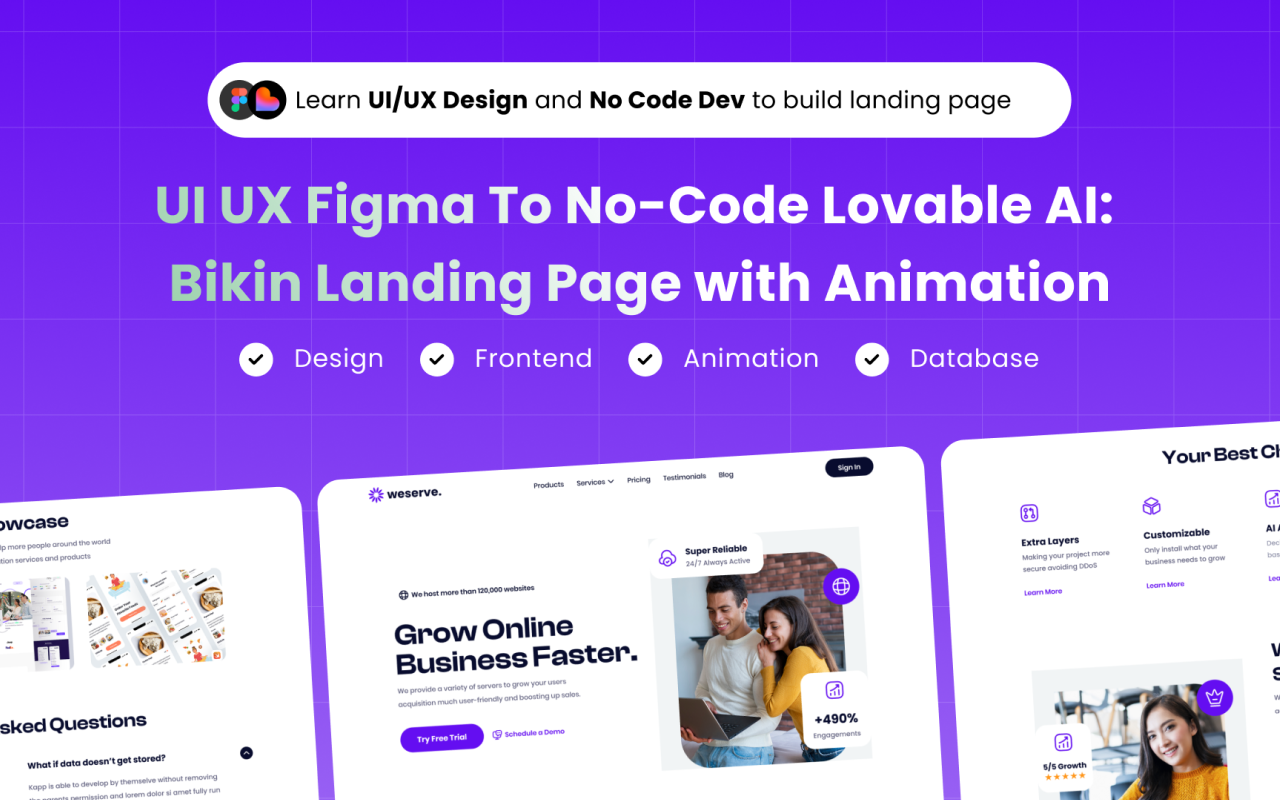
6. UI UX Figma to No-Code Lovable AI: Bikin Web Paket Umroh
   ├── Apa: Figma design ke working website
   ├── Topics: Design, no-code, AI
   ├── Output: Travel booking website
   └── Link: buildwithangga.com/kelas/ui-ux-figma-to-no-code-lovable-ai
Full-Stack Project Classes
PROJECT-BASED LEARNING:

1. Full-Stack Laravel 12 & Vue 3: Website Desa Digital
   ├── Apa: Complete full-stack application
   ├── Tech: Laravel 12, Vue 3, MySQL
   ├── Features: Multi-role, payment integration
   └── Link: buildwithangga.com/kelas/full-stack-laravel-12-vue-3-website-desa-digital

2. Full-Stack Next JS Laravel 11: Web Langganan Catering
   ├── Apa: Modern full-stack dengan API
   ├── Tech: Next.js, Laravel 11, FilamentPHP
   ├── Features: Subscription system, dashboard
   └── Link: buildwithangga.com/kelas/full-stack-next-js-laravel-11-web-catering

3. REST API Classes (GoFiber, Laravel, Node.js)
   ├── Apa: Backend API development
   ├── Output: Production-ready APIs
   └── Link: Various classes available

4. Belajar Menjadi Freelancer Backend Developer 2025
   ├── Apa: Freelance skills + technical
   ├── Topics: Client handling, ERD, implementation
   └── Link: buildwithangga.com/kelas/freelancer-backend-developer-2025
Recommended Learning Path dengan BWA
LEARNING PATH DENGAN BUILDWITHANGGA:

BULAN 1-2: Foundation
━━━━━━━━━━━━━━━━━━━━━
Week 1-2:
├── HTML CSS JavaScript free classes
└── Practice: Build 2 landing pages

Week 3-4:
├── React atau Vue basics
└── Practice: Build interactive app

Week 5-6:
├── Laravel atau Node.js basics
└── Practice: Build simple API

Week 7-8:
├── Git & GitHub
├── Deployment basics
└── Practice: Deploy projects

BULAN 3-4: AI Integration
━━━━━━━━━━━━━━━━━━━━━━━
Week 9-10:
├── Ebook Full-Stack AI-Powered Developer
└── Practice: Integrate AI API

Week 11-12:
├── Membuat Chatbot AI dengan No-Code
└── Practice: Build AI chatbot

Week 13-14:
├── UI/UX Vibe Coding class
└── Practice: Build dengan Lovable AI

Week 15-16:
├── Explore more AI tools
└── Practice: Build AI content tool

BULAN 5-6: Real Projects
━━━━━━━━━━━━━━━━━━━━━━
Week 17-20:
├── Full-Stack dengan Lovable AI class
├── Build: Your own AI product MVP
└── Focus: Ship something real

Week 21-24:
├── Polish portfolio
├── Write case studies
├── Prepare for jobs
└── Start applying / freelancing
Closing: Your Journey Starts Now
Kita sudah cover banyak hal dalam artikel ini:
RECAP:
━━━━━━
✅ Apa itu AI Product Engineer
   → Hybrid role: Product + AI + Development

✅ Job description & responsibilities
   → Discovery, Design, Build, Test, Ship

✅ Skills yang dibutuhkan
   → Product thinking + Dev skills + AI mastery

✅ Tools yang digunakan
   → AI APIs, Cursor, Lovable, Supabase, etc

✅ Contoh output kerjaan
   → Website builder, chatbot, content tools, etc

✅ Cara belajar step-by-step
   → 6-month learning path

✅ Cara menyiapkan portfolio
   → Structure, case studies, presentation

✅ Gaji dan career path
   → Rp 8-75 juta/bulan depending on level

✅ Kelas BuildWithAngga untuk memulai
   → Foundation + AI + Full-stack classes
The Opportunity is Now
AI Product Engineering adalah salah satu career paths paling exciting di tech saat ini. Kenapa?
Supply-demand gap: Banyak company butuh orang yang bisa ship AI products, tapi talent yang qualified masih sedikit.
Tools sudah accessible: Kamu tidak perlu PhD atau jutaan dollar budget. APIs dan no-code tools membuat AI product building accessible untuk siapa saja yang mau belajar.
Leverage is massive: Satu orang dengan skills yang tepat bisa build apa yang dulu butuh tim besar. This is unprecedented.
It's early: Kita masih di early innings. Yang mulai sekarang akan punya significant advantage.
Your Next Steps
ACTION ITEMS:

TODAY:
├── Bookmark artikel ini untuk reference
├── Sign up OpenAI API (platform.openai.com)
├── Download Cursor (cursor.sh)
├── Join BuildWithAngga community
└── Set learning goal untuk minggu ini

THIS WEEK:
├── Build "Hello World" dengan AI API
├── Explore Lovable AI
├── Identify 1 problem yang bisa di-solve dengan AI
└── Start documenting learning journey

THIS MONTH:
├── Complete Phase 1 foundation
├── Build dan deploy first AI project
├── Create basic portfolio
└── Share progress di social media

IN 3 MONTHS:
├── Have 3+ AI projects in portfolio
├── Apply untuk jobs atau start freelancing
├── Continue learning dan building
└── Help others yang baru mulai

IN 6 MONTHS:
├── Landed first AI Product Engineer role
├── Atau: Have paying clients sebagai freelancer
├── Atau: Launched own AI product
└── Teaching others what you learned
Final Words
AI Product Engineer bukan role untuk "orang jenius" atau "yang sudah expert". Ini role untuk siapa saja yang:
- Curious tentang AI dan product building
- Willing to learn dan experiment
- Not afraid to ship imperfect things
- Consistent dalam belajar
Saya mulai dari nol di AI product building. Melalui banyak trial and error, learning from failures, dan consistent building — sekarang products seperti Shayna AI sudah melayani ribuan users.
Journey-nya challenging. Ada hari-hari frustrating ketika AI tidak behave seperti expected. Ada moments doubt apakah ini worth it. Tapi overall? Incredibly rewarding.
Sekarang giliran kamu.
Tools sudah ready. Knowledge sudah accessible. Community siap support. Yang dibutuhkan cuma satu: kamu mulai.
Pilih satu kelas. Build satu project. Ship satu thing. Start today.
The best time to start was yesterday. The second best time is now.
See you di dunia AI Product Engineering! 🚀
Akses kelas AI dan development di BuildWithAngga: buildwithangga.com
Join komunitas untuk support dalam learning journey kamu.
Punya pertanyaan? Drop di kolom komentar atau reach out via social media.